

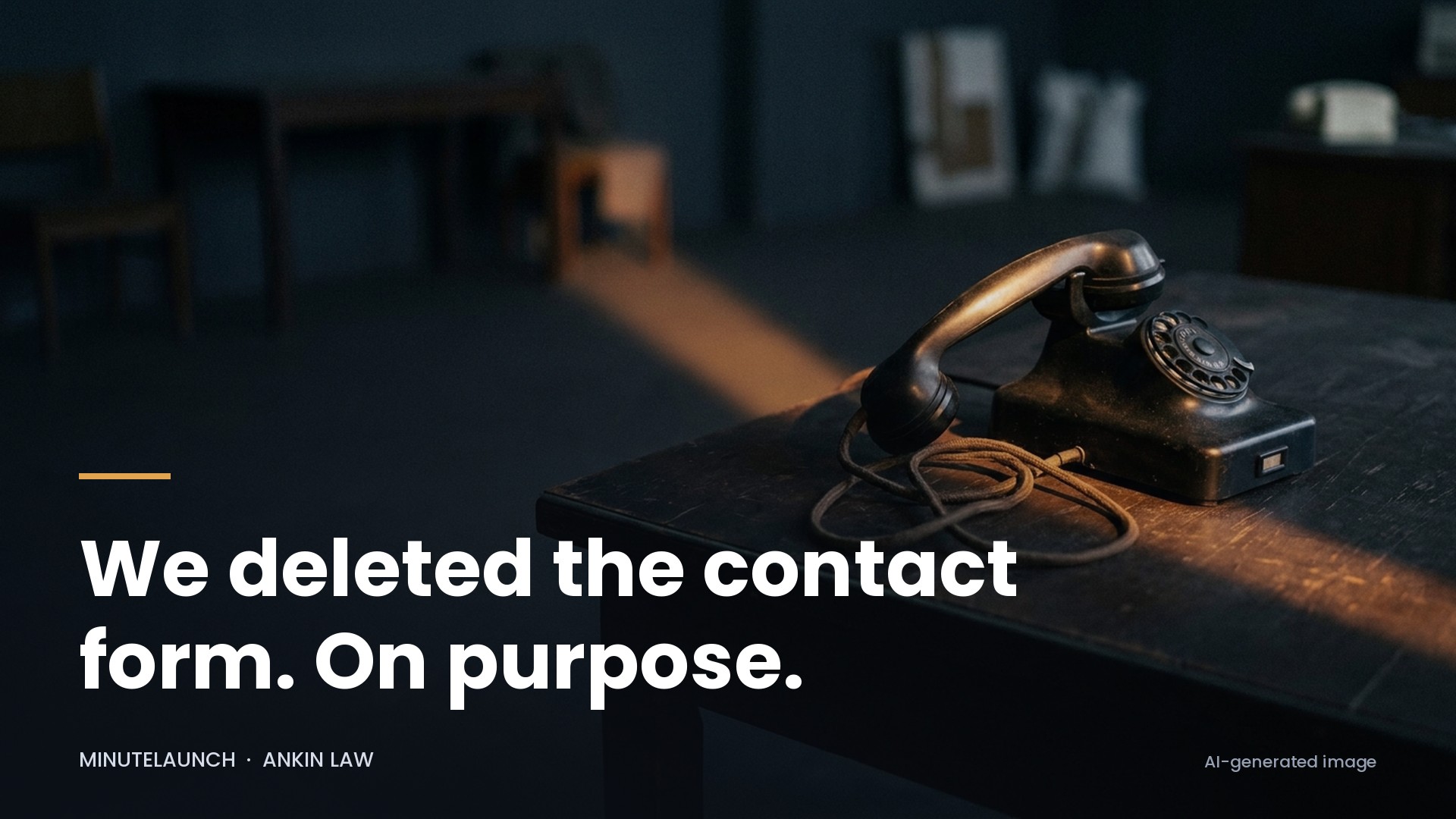
We deleted the contact form. On purpose.
The firm told us nobody works the email leads. So we took the form off every page and pointed all fifteen at the phone instead. Here is why that was the right call.
Last week we stripped the contact form off every landing page on a law firm site. Name field, email field, tell-us-what-happened box, submit button. All of it, gone, on fifteen pages.
It was not a design decision.
What the firm told us
They said something most firms will not say out loud. Nobody works the email leads. Never really have.
The form was there because a form is what you put on a page.
Sit with what that means
Somebody gets hurt. They find the page at eleven at night, which is when people look for this.
They type out what happened to them — the accident, the injury, the part where they are scared about money — into a box on a website belonging to a law firm. They hit send. They get a thank-you message.
And then nothing happens. Ever.
That is not a missed lead. A missed lead is a business problem. That is a bad experience you paid a developer to build, running twenty-four hours a day, aimed at people in the worst week of their lives.
A form nobody reads is worse than no form
Worse, because it absorbs the intent.
The person who would have called does not call. They think they have made contact. They wait. Then they hire whoever answers the phone.
What replaced it
Each page now has exactly one thing to do. A phone number, tappable, in the middle of the page, sized like it matters. Not a form, not a chat widget, not a callback request.
You can see the finished layout on the dog bite page or the construction fall page. Scroll to the bottom. There is one thing there.
The firm answers phones twenty-four hours a day, and they are good at it, so the entire page points at the thing the firm is actually good at.
You have one of these
The uncomfortable version of this. Every marketing stack I look at has at least one.
A form going to an unmonitored inbox. A chatbot nobody trained. An after-hours voicemail nobody plays. A “book a consultation” calendar with no one behind it.
It got installed during a redesign, it looks professional, and it quietly makes people feel ignored.
The half nobody sells
Half of marketing is adding things. The other half is having the nerve to take things off.
The second half is much harder to sell, because nobody has ever put “removed a feature” on an invoice.
Why this was right for this particular firm: Ankin Law answers the phone twenty-four hours a day, with people, including at eleven at night. It probably helps that Howard Ankin sits on the board of Chicago Volunteer Legal Services. When I framed this as “what happens to the person who wrote to you,” nobody at the firm argued.
What is on your site right now that nobody on your team actually monitors? Everybody has one. Mine was a contact form on my own site for about two years.
Spencer Forman builds AI media and marketing systems with MinuteLaunch. The work described here was done for Ankin Law, a Chicago injury and workers’ compensation firm. The videos are AI-generated and labeled as such on every page.